

Emotional resilience is your ability to recover quickly after you get triggered, so that you can take a purposeful, value-oriented emotion. The more emotional resilience you have, the less you fall into defensiveness or emotionalism.
Why emotional resilience is important
This capacity is important for both productivity and communication.
If you are pursuing an ambitious goal, you will hit setbacks and problems along the way. This will trigger threat-oriented emotions such as fear, discouragement, and frustration. You need to be able to correct your course fairly quickly. That requires both processing the emotions and redirecting your action toward a value that can help you overcome the setback. How fast you can do so will determine your overall productivity.
The need for speed is even more acute when you’re talking with others. If they say something that triggers a defensive reaction in you, you want to recover before you blurt out a defensive comment. The sooner you can re-orient to values, the more likely you will have a fruitful conversation and strengthen the connection between you.
How you increase emotional resilience
Emotional resilience is a complex product of knowledge, values, and skill, which means there are a lot of ways to increase it. For example, doing the exercise “Three Good Things” every day helps you become more aware of your values, which makes you faster and more accurate at naming them on the fly. A daily process of celebration and mourning helps you not just clarify your values, but also strengthen the most important ones. It helps prioritize your implicit value hierarchy, so that the emotions that get triggered are more in alignment with your conscious convictions.
These are just two of the “emotional resilience tools” I suggest to participants in the Launch program. For the duration of the 8-week program, Launchers build one of these short daily practices into their days. The daily practice is designed to boost their overall motivation in the short term, plus make it easier to activate motivation to work on their goals in the long term.
Many Launchers maintain such a daily practice long after Launch has finished. These are not quick fixes, but over two months, you can see the effect on your mind and your emotional resilience.
As a result, repeat Launchers have gotten inspired to invent their own variations and new emotional resilience tools. The newest is the “Value Jars.” This is a tool that helps you internalize “deep rational values.”
The benefits of internalizing “deep rational values”
Deep rational values are values in a philosophic sense. They are not the values you happen to hold, but rather phenomena of general theoretical value because of how they relate to the nature of man, the world, and man’s role in the world. I explain them in detail in my article on the topic, but just to concretize, here’s a list of them:
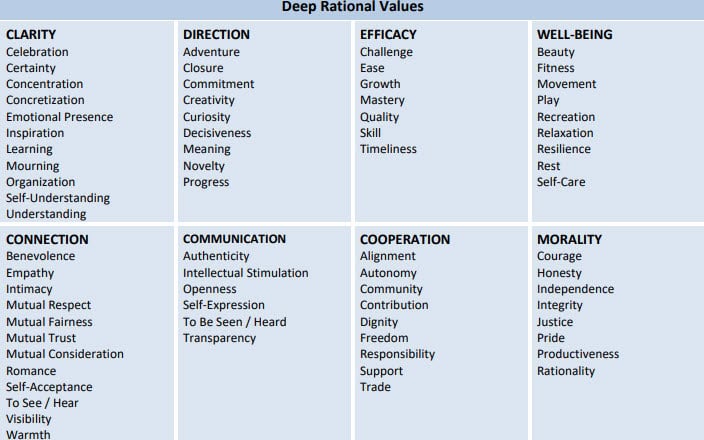
* This is my adaptation of Marshall Rosenberg’s “Universal Needs.”
I first discovered these concepts in the form of lists of “universal needs,” which are used in classes on Marshall Rosenberg’s “nonviolent communication.” Having a list in front of you helps you quickly work through the emotions in a conversation.
I was sold on the utility of the list, but not on Rosenberg’s explanation of what the concepts are. With a few exceptions, his “universal needs” were highly rational values, directly related to principles of rational selfishness. And the ones that weren’t were obviously not universal, since I didn’t hold with them.
So I put on my philosophic-detection hat to analyze each concept on his list. I took 10–15 minutes a day to think about one concept at a time. The obvious result was my reconceptualization of these concepts as “deep rational values.” That’s what caused me to create the list you see above.
The less obvious result was that I internalized these concepts and started seeing their relevance everywhere, not just in communication, but in every aspect of managing motivation. Since then, I have recommended that others go through this process for themselves. But it didn’t catch on until a little over a year ago, thanks to some help from my friends.
The invention of the Value Jars
About a year ago, Earl Parson heard me recommend analyzing the deep rational values. Being an architect, his mind went to the esthetic and emotional enjoyment of the process. He suggested one could put the concepts on slips of paper and then store them in a beautiful container. He thought this would make a good emotional resilience tool. You would pull out one concept each day, randomly. Rather than slog through the table, add a little surprise and whimsy to the process.
Lin Zinser jumped in and started doing it. Within a month, she was telling everyone about how helpful it was — me, her coaching clients, Thinking Labbers, and Launchers. She persuaded a number of people to try it, including Stephanie Bond, whose Value Jars are shown in the picture above. There are two beautiful containers, one for the concepts you have already analyzed, and another for the ones yet to go.
Stephanie explained why she used such different containers. The lidded jar holds the concepts to choose from each day. The vase holds the used slips. She says it’s easy to drop a used slip into the vase, but not so easy to pull one out! The neck is too small. This way she never forgets which container is which.
Options for how you analyze the deep rational values
There are several options for what you do each day. My original recommendation was to look at each concept to decide if you think it belongs on the list. The three criteria (explained in the article) are:
- Is it a value at all?
- Is its value directly related to reason as man’s means of survival?
- Is it a value in principle?
This is excellent if what you want is philosophic understanding. But when I first went through the concepts, I didn’t have this analysis, so I just asked myself, “Do I think this is a value? Why?”
Stephanie has been through the jar of concepts with a more personal approach multiple times. She says she asks herself such questions as:
- What does this mean? Do I need to look it up in the dictionary?
- Is this already a top value? Why or why not?
- Would I like to have more of this value in my life? How can I do that?
Lin recently came up with the variation: “Think about how this value relates to my major goal.” That would be a great way to keep your goal top of mind and to strengthen your passion for it, while also getting the benefits of internalizing the deep rational values.
We’re preparing sheets of deep rational values to make it easy for the next set of Launchers to try this tool. I look forward to hearing about the new variations they come up with!
The benefit of attention on deep rational values
The practical effect of this process is that “deep rational values” will occur to you spontaneously when they are relevant. That happens because you have programmed your memory banks so that these values are more easily triggered. You did that in three ways:
1) One day at a time, you put significant attention on each concept. Attention is the means whereby an idea is programmed into memory as important. The more important, the easier the idea is to trigger.
2) Your thinking concerned the benefit of that phenomenon to you and your life. You integrated it with your existing values. The more value connections to an idea, the more easily it is triggered.
3) Your thinking concerned concrete instances of the values. The deep rational values are abstract and general. Connecting them to concretes organizes your knowledge and makes it easier for them to trigger in response to real-world events.
In other words, the work involved is not memorizing a list of words. It is integrating them with your knowledge and values. That — the conceptual connections with your existing values — is what makes introspecting your emotions and re-orienting to values faster and easier. And doing that quickly is having emotional resilience.
That is a huge benefit for a commitment to 15 minutes a day for just a few months.
P.S. We have made sheets to print to make the slips with deep rational values. There is a small version and a large version.




0 Comments