
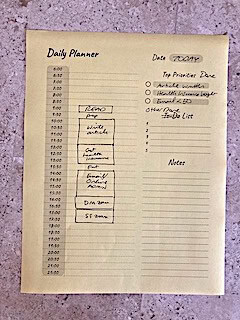
What skills are needed to follow through on a plan for the day? A plan that was made up at least one day before? And actually get the tasks accomplished in the time allotted for them?
That is a question I have been working on for some years. The idea of deciding the schedule ahead of time was touted by a teacher of mine, Brooke Castillo. Her arguments for its benefit were convincing, but I had great trouble doing it. This was especially true of any writing, which never seemed to follow the plan. And since my most important work involves writing, this meant most days I did not follow my plan.
That has suddenly changed. A final part of the puzzle clicked in place recently. I made a couple of small changes in my routines that have made a big difference. There is one theme to them: You need to curate your attention to stick to the plan.
Don’t look at your priorities
First of all, I no longer look at my full week priorities list in the morning as part of getting started on the day.
Now, I only look at the whole priorities list a couple of times a week. Once is when I update it on Sunday. I use the list to schedule assignments on my calendar for the week. I also refer to the whole list when I meet with my assistant and whenever something comes up during the week that needs to be added to it. But those things happen in the afternoon. The morning is strictly for writing.
I’m more likely to look at one of the categories on the priorities list. Sometimes the assignment I put on the calendar is the name of a category such as “Email and online admin.” When I do work on that assignment, I’ll look at the priority list for that category, and do the top tasks from that category that fit in the time.
Minimizing attention on the week’s priorities list turns out to be important. It means I don’t second-guess my decisions about what to do today or when to do it. This is necessary if you are trying to develop a skill of sticking to yesterday’s plan.
In hindsight, the week’s priorities are a context I don’t want to warm up before undertaking hard tasks, especially before writing. Instead, I just look at my calendar to see the schedule for today — what work do I need to do next and how much time do I have budgeted for it.
Don’t explore what’s on your mind
Similarly, I don’t do generic journaling in the morning. I used to spend at least 15 minutes thinking about whatever was top of mind. It was very interesting, but it often concerned work I had done the previous day, or work that was scheduled for a future day, or new thoughts that occurred to me overnight.
One of the hazards of my profession is that anytime I introspect, I am likely to produce interesting raw material for further thinking about my method, what I’m learning, how it relates to my integrated understanding of psychology, etc. That is great work, but at this stage in my career, it conflicted with settling down to start a scheduled task.
This doesn’t mean I’ve stopped journaling. I’m actually journaling more. But not as part of starting my day. I discovered that I need to do my journaling more deliberately in conjunction with task transitions. I now assume that I will need to warm up the context and the motivation to do the next task on the schedule. So I do my thought work as part of starting a task, not starting “the day.”
How I warm up my motivation
I have a particular process I use to warm up my motivation, adapted from Brooke Castillo, which uses her self-coaching model. It has these five steps:
1) Do a thought download of everything on your mind, in sentences. This is not thinking; this is just a core dump of the thoughts floating around at the moment.
2) Pick out a significant thought and see how it’s motivating you.
3) If it’s not motivating a virtuous cycle of success, think on paper about that. Figure out why not. (In this process, you sometimes find that you just need a different mental set. You sometimes find a contradiction in your own thinking that you can correct. You sometimes find a familiar self-defeating belief that you are working to disintegrate.)
4) Based on what you figure out in step 3, come up with a better leading thought and test to make sure it will motivate you on the task and set up a virtuous cycle.
5) Attempt the task and monitor. If you get in the groove, keep going. If you don’t, or you stall, iterate.
(I don’t expect you to be able to perform this process after just reading these steps. Thinking Labbers can visit the Library for a detailed writeup on this tactic and references to where it is taught in the self-study courses.)
I had been using this process successfully for some years, but not for sticking to a schedule. I only figured out recently that I shouldn’t just do a thought download of any thoughts I was having. I needed to do a thought download of all of my thoughts about starting the next task! I needed to set a clear intention for my thought download!
Downloading my thoughts about the upcoming task makes all of the difference.
Zeroing in on motivation for the task — or lack thereof
This doesn’t mean that I censor thoughts that are off-topic. So, for example, here’s the thought download from when I started working on this article:
All of the thoughts [about starting work on the article]
But I don’t know if I should do it on Tara’s line.
But I had an idea I should do “Get Started.”
But I’m not in the mood.
But I want to work on the speech.
AND I said I’d do this.
AND I want to decide ahead of time.
AND the last article I wrote only took 1.5 hours to complete.
AND I need to get started quickly.
AND that means I need to decide the topic.
AND what if the topic is no good!
Notice the line, “But I want to work on the speech.”
I know myself. If I hadn’t set a different intention, thoughts about “the speech” would have dominated. The speech was on my mind when I sat down at my desk. The download would have looked more like this:
All of the thoughts [imaginary — without special guidance]
But I want to work on the speech.
AND it’s important.
AND I have a lot of work to do before Saturday.
But I said I’d write an article.
But I don’t even know the topic.
AND I have some great ideas for the speech.
I don’t want to lose that context.
Why don’t I just spend a little time making notes on those ideas?
Where you put your attention determines what comes up next from your memory banks. If I had started with what was on my mind, more about the speech would have come up. That would have been in conflict with the goal of writing an article. In contrast, by setting the intention “thoughts about starting the article,” the first few thoughts were about the assignment.
The speech was still on my mind for a while, but it just showed up as one distracting thought. And by then I had warmed up enough of the relevant context, including the fact that my intention was to work on the article! That gave me extra motivation to answer the objections with a little determination.
Focusing my attention on the article and my intention to work on it warmed up sufficient motivation that the speech became a non-issue.
No substitute for looking at the problem
Most importantly, by focusing on the topic, I discovered that I felt angst about choosing the “wrong” topic. The final line of the original thought download, “AND what if the topic is no good!” made the motivational problem clear to me.
This reflected old baggage, a real issue for me. In the 20+ years I’ve been writing articles for my newsletter, I have probably thrown out half again as many articles after putting in more than two hours on them because I decided the topic was inappropriate or too complex. There is a long history of difficulty on this in the background.
If I hadn’t identified this baggage in less than 5 minutes, it would have been a huge source of resistance to starting; I could have had motivational problems for hours without really knowing the cause.
Instead, when I realized what was up, I turned my attention to that issue. I was able to come up with a simple, small, short, slow way to vet the two topics I had thought of. (Hat Tip to The Practicing Mind.) I tested it and was motivated by this topic, and sure enough that got me off and running on writing this article.
I needed to put enough attention on the task at hand to activate my motivation. Without that, I could not have introspected to discover that I needed to reorient to values and bolster my motivation to follow through.
Now that I’m using this process regularly, I find that my motivation needs bolstering frequently. So I now have a standing order: Start by curating my attention with a thought download. Use that to see whether my motivation needs bolstering or not.
Following a daily plan
Curating my attention as I get started appears to be the last process change I needed to be able to schedule my days in advance to make my productive output predictable.
But to be clear, there is much more involved in following a daily plan. This is the final one of dozens of processes I’ve implemented during years of experiments. Your goals need to be set in a way that motivates. You need a repeatable daily schedule — including a sleep and wakeup time. You need a repeatable weekly schedule so that you can plan the week. You need a lot of experience doing tasks so that you can predict how long they’ll take. You need to have minimized buffering. And/or, you need to be able to do steady, incremental work on a long-term goal that won’t get finished today. Etc.
And I’m sure there will be more for me to learn about following a daily plan. Occasionally something will come up in my thought download that will turn out to be much more important than my planned task. How will I handle it? I may need yet another new process.
But the point of this article — that you need to curate your attention in order to follow your plan — is a critical piece of the puzzle.






0 Comments