
To “wobble” is to start to lose your balance. When it happens, you make a quick adjustment and move on. How you make the adjustment depends on how you are moving.
If you’re walking down the stairs, you grab the railing or the wall. If you’re on a bike, you turn slightly in the direction you wobble. If you are playing tennis, you get up on your toes making tiny, fast steps in the direction you wobbled. These are things we learn to do as we master physical activities. Once we learn them, they become automatic reactions of the perceptual-motor system.
When you wobble mentally, it’s a little different. (Hat Tip to Shona Cameron for this analogy.)
You had an intention — say, to have a conversation with your partner — but now you are hearing a warning bell that indicates you may be going off track. Maybe your thoughts are suddenly scattered. Or you feel surprisingly emotional. Or you met with unexpected friction.
The moment you notice the wobble is the best time to intervene. But unlike riding a bike, you can’t count on an automatic reaction. You need a “Wobble Recovery Plan.”
The basics of a wobble recovery plan
The problem is that seeing yourself going off track doesn’t tell you how to stay on track. At the conceptual level, there is no built-in vestibular system to help with rebalancing. It’s all volitional and introspective, so the first thing you need to do is to identify what’s going on. You do that by introspecting your wobble experience and naming it. Expect it to be one of these four or some combination:
- Physical pain
- Overload
- Worrisome thoughts
- Awful emotions
These experiences are created by the memory-affect system. Sometimes they reflect the present state, which is the case with physical pain and overload. These are signals for an urgent need to change your action.
On the other hand, worrisome thoughts & awful emotions reflect an expectation of the future. These expectations are based on past experiences that were stored in memory and have been activated by your present awareness. They require further introspection to determine whether they are based on a valid concern.
In none of these cases is the remedy obvious. You need to learn to distinguish them, understand how they cause you to lose your balance, and figure out how to recover in each case.
Physical pain
Physical pain is an alert that damage is happening now to the body. To quote Leonard Peikoff, “Damage untended is progressive.” Pain indicates an urgent need to stop what you’re doing to take care of your body.
To be clear, pain is not the same as discomfort. It’s important to be able to distinguish these. Tiredness, achiness, muscle fatigue and the like are uncomfortable and unpleasant, but they are not instances of physical pain per se. You can work through them for a time and indeed that is how you build endurance. But if you continue past the point of pain, you need to stop.
Being non-athletic as a kid, stopping was all I knew to do to manage pain for a long time. Then, in my late 20s, tendonitis started to directly interfere with my typing, and I needed to learn alternate ways to do tasks without pain. The Alexander Technique has been the key for me. I also have created many physical routines to keep me pain-free involving sleep, exercise, and work limits.
My latest addition to this suite of tactics is tightening my core when sitting. This often eliminates neck, shoulder, and forearm pain, and makes the Alexander Technique more effective. Apparently core strength matters a lot if you want to sit at your desk all day.
My advice: If you experience chronic physical pain, make it a priority to find a non-opiate solution that eliminates it for you. There are many centers that specialize in teaching you to manage pain through a wide range of means, including breathing, movement, diet, and mindset work.
Overload
Overload in this context is a shorthand for any dysfunctional mental state: overload, blankness, and confusion are the biggies. They are dysfunctional mental states because you literally cannot think in these states. The material coming up from your subconscious memory banks is mismatched with your intended purpose.
The solution is always to switch your purpose to something simpler and/or easier. The simplest is: Make a list. Get whatever is in your head out onto paper. Then you can decide what to do about it.
The worst thing you can do when you’re overloaded is to just “try harder.” When you’re overloaded, you don’t have enough crow space to make the connections you need to make. “Trying harder” just adds pressure. In fact, it uses up some crow space instead of making more available.
There are lots of tactics for dealing with dysfunctional states. My Thinker’s Toolkit has several, including my #1 go-to tactic, Thinking on Paper. And the Thinking Lab library has about a dozen tactics just for getting your mind back in gear when it’s stopped.
I continue to invent new methods for reducing overload related to communication. I see this as discovering more about the mental process of essentialization. It’s easy to put forth a complicated explanation. It’s not easy to take what appears to be complicated and reduce it to its essentials so that it can be explained in a simple, logical manner. But that makes all the difference in communication.
Worrisome (threat-oriented) thoughts
“Worrisome thoughts” is a placeholder for any thought that activates a threat-oriented context, i.e., threat-oriented thoughts. Your attention to the idea activates knowledge of what’s wrong, what’s bad, what’s scary, what’s impossible, what disaster is brewing, etc. We’ve all been there.
The real tragedy of activating a threat-oriented context is that it’s often caused by old baggage. Past difficulties color your present evaluations and expectations — whether they are relevant or not. This is why it’s so important to check the validity of these thoughts.
The basic remedy here is to challenge each thought. Is this literally true? Or are you exaggerating? Does this really follow? Or are you jumping to conclusions? Does this really matter? Or are you making mountains out of molehills? A standard part of cognitive-behavioral therapy is to look for and challenge such thought errors.
If the threat is real, the thing to do is to figure out how important it is to address this threat now. If it’s important, what will you do about it? If it’s only a potentiality or it doesn’t pertain to what you’re doing, it shouldn’t be taking up your mental space now.
If your thoughts are threat oriented, it’s important that you don’t continue business as usual. Once a threat-oriented context is activated, it distorts your thinking and your motivation. Unchecked, it motivates a vicious cycle of action: Your pressure-filled intentions backfire, or your despair becomes a self-fulfilling prophecy, or your focus on negatives makes the situation worse than it would have been.
Ultimately, addressing threat-oriented thoughts is mindset work, which is important for personal productivity and happiness. You need to be oriented to values, not threats, to live a highly successful life. My go-to process for reorienting to values these days is Stacey Boehman’s “Intentional Thought Creation” technique which helps you focus on and validate aspirational thoughts.
Threat-oriented emotions
Sometimes there are no words. There is just a wave of resistance. Or fear. Or despair. Or guilt. Or frustration.
These all feel awful. More technically, they are threat-oriented emotions and they can trigger a vicious cycle just as effectively as a threat-oriented thought.
One reason they feel so awful is that when you are caught in the wordless experience, its awfulness feels like a metaphysically given fact. It’s not, but there is nothing clear to latch onto.
That’s why the first step in addressing such a wobble is self-compassion. You need to accept that you are in an emotionally difficult place, and you don’t know how to get out of it just yet. Once you have taken charge, you can introspect the emotions and find the underlying ideas. Then those need checking. Some will be false or irrelevant. Others will be threat oriented and require more troubleshooting. As you shift your attention and your line of thinking, the emotions automatically shift too.
If you don’t intervene, the default in these cases is a defensive reaction. Defensive reactions include fighting or other acting out, fleeing to some more pleasant activity, or shutting down emotionally. These are learned ways to feel better. They feel better than guilt, despair, etc.
Dysfunctional action
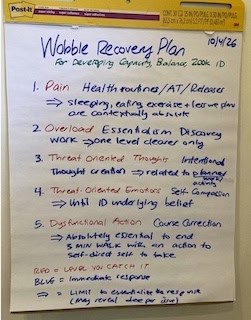
You may notice that my “wobble recovery plan” (shown in the picture) includes a fifth entry for “dysfunctional action.” These are the bad options that I mentioned above as something to avoid, i.e., continuing action despite increasing physical pain, pressuring yourself to “just do it,” spiraling into negativity, and reacting defensively. I call these dysfuntional actions because they all backfire in some way. They make the situation worse.
Any one of them is evidence that you didn’t catch a wobble before you lost your balance. That means that the problem has escalated and needs a larger scale response. You need “course correction,” which is an integral part of the self-direction process I teach in the Thinking Lab. It has three basic parts:
- A physical pause: To break out of a vicious cycle, you need to take a physical pause such as the three-minute walk.
- Activate a self-esteem context: Remind yourself of your basic worth and efficacy. (I talk about this more here.)
- Now you are ready to address the problem from a position of strength. What is the problem? How can you solve it? What is the next step?
If you are new to this idea and you don’t catch a wobble immediately, just notice that it’s harder to get back to a value orientation once you start down the slippery slope of threats. It may take some muddling through to regain your perspective. (Or, of course, you could join the Thinking Lab and get tactics and coaching on all of this!)
The moral of the story
The moral of the story is: No matter what your skill or success level, you will wobble from time to time. It pays to develop a wobble recovery plan made up of tactics that you know how to execute. Because the faster you can recover from a wobble, the more success and happiness you have in the world as it is.




0 Comments