
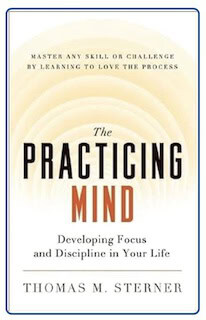
I recently read The Practicing Mind by Thomas Sterner, and I highly recommend it. The topic is how you continue to grow your skills to a higher and higher level by means of systematic practice. He is a musician and concert-piano tuner and reached a high level of proficiency in both.
The need for a positive experience while pursuing long-term goals
What grabbed me immediately is his attitude toward growth. He recognizes (as do I) that the process of long-term growth needs to be a positive experience. This is particularly crucial when you are developing a motor skill such as piano playing. As he points out, you need to love the practice, not just love the achievement. That’s because your standards go up as you get better. The goalpost moves. If you aren’t careful, you can fall into the trap of “never good enough” because “good enough” changes relative to your current skill level.
I make this same point with respect to all long-range goals. You need to get joy out of the steps along the way. You can’t just expect to get one jolt of ecstasy in 10 years when you’re done. You need pleasure along the way to motivate the action and to build the strong values that enable you to sustain that action over years or decades.
KISSSS for practice
Previously to reading this book, I ensured that continuous payoff through “planned evolution.” That’s how I’ve coached people to achieve their long-term goals in Launch. But Sterner gave me another alternative: KISSSS.
You may know the acronym KISS, which means, in my mind, “Keep It Simple, Sweetie.” It’s good advice as long as you don’t use some derogatory term for the final “S.” But Sterner’s approach goes three steps further:
- Simple
- Short
- Small
- Slow
This is his advice for practice of a complex skill. Whatever you are practicing now, you need to judge your success, not on whether you succeed overall, but whether you succeed at the simple, short, small, slow thing you are paying attention to.
Reducing overload and seeing incremental success
I applied this to playing tennis. I’m still a beginner. Though I’ve developed good form, I have no game smarts. When I’m in an actual game, I tend to get overloaded by thinking of all the coaching advice I’ve been given, and I play less well than I do in lessons. The KISSSS technique helped me reduce that overload and find ways to see incremental success.
After reading this book, I decided that I needed something simple, short, small, and slow to practice during a game so that I could actually improve my game performance. I came up with one thing: the split step. This is readiness action that my coach has taught me. You take a split step the moment the other person hits the ball, and it puts you in a position to start moving in the right direction.
To do a split step, you need to slow down and stop moving. It’s simple (one instruction). It’s short (it takes little time). It’s small (it doesn’t require any athletic prowess).
I only came up with this strategy after I was sorely behind in the score. From then on, I judged each swing by whether I had done a split step. If I had, I cheered silently. If I hadn’t, I used Sterner’s “Do, Observe, Correct” process, and tried to apply the correction to the next swing. My game improved dramatically, and I learned something important about how to react to the ball.
The KISSSS strategy is a keeper and this terrific little book is a quick read. I commend it to you.



0 Comments