
I opened this series by asserting that the Thinker needs to develop certain characteristic ways of thinking:
- Decisive
- Essentialized
- Principled
- Creative
- Value-Oriented
Parts 1–3 explained what I meant by these and discussed how these characteristics are the product of skill. In this fourth and final part, I relate my analysis to other analyses of thinking.
Why isn’t critical thinking included?
Mainstream discussions of thinking skills typically divide thinking into creative thinking and critical thinking. I previously explained my view of creative thinking, but nowhere have I mentioned critical thinking. That’s because what appears under the heading of “critical thinking skills” is a hodgepodge, and I was endeavoring to analyze thinking in terms of essentials. My categorization is made possible by Ayn Rand’s philosophical discoveries, which revolutionize our understanding of thinking processes.
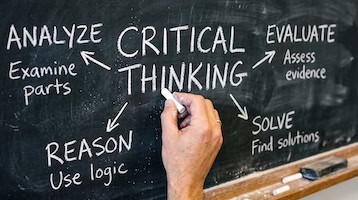
To illustrate that “critical thinking skills” is a hodgepodge compared to my analysis, we need only study the picture I used for this blog post. I found this picture by searching on “critical thinking skills” in my stock photo service. AI generated the picture, which shows four categories of critical thinking:
- Analyze: Examine parts
- Reason: Use logic
- Evaluate: Assess evidence
- Solve: Find solutions
To be clear, I am in favor of everything listed here. But these are not the essentials of thinking. I’ll take them in the order presented.
Analyze: Examine parts
The first category is “analyze,” which means break into parts, then examine the parts. You do this to understand the nature of each part and its distinctive role in the whole. Synthesis, the complementary process, concerns understanding the whole as the sum of the parts.
The key to successful analysis is the choice of how to divide the whole into parts. Are the parts you choose the essential parts? Harry Binswanger concretized this with the example of carving a chicken. You could cut it into parts by just hacking it to pieces with an axe. But when you carve a chicken, you choose to cut it at the joints. You ensure that each part is its own whole — a wing, or a breast, or a drumstick.
The equivalent in thinking is essentialization. An analysis succeeds or fails based on whether the choice of division is essential or not. So analysis is a minor topic under essentialization, not a major category of thinking.
Reason: Use logic
My mind boggles at the second category, which is “Reason: Use logic.” To put it simply:
- Equating reasoning with using logic is mistaken.
- Treating logical processes as a category of thinking is mistaken.
Any Rand radically clarified the relationship of reason, thinking, and logic. Some lines of hers that may be familiar to you:
- “Reason” is “the faculty that identifies and integrates the material provided by man’s senses.”
- “The faculty that works by means of concepts is: reason. The process is thinking.”
- “All thinking is a process of identification and integration.”
- “His means to establish the truth of his answers is logic… Logic is the art of non-contradictory identification.”
In short, reasoning is thinking. Thinking skills are reasoning skills. All thinking is logical. Logical thinking is a redundancy. So-called “thinking” that is not logical is not thinking!
All of the other processes listed (analyze, assess evidence, solve) require the use of logic and are exercises of the faculty of reason. So are all of mine (decisive, essentialized, principled, creative, value-laden). So treating “reason” or “using logic” as a category of thinking is mixing levels of analysis.
That said, I am not surprised that reason is equated with logic in this AI-generated picture. The mainstream thinks of logic as syllogistic reasoning. It doesn’t think logic applies to creative thinking or any value-laden issue. It sees those processes as illogical, subjective, and even irrational. But as I explained last time, they aren’t.
Evaluate: Assess evidence
The third category is “Evaluate: Assess evidence.” This is mixed up, too. An “evaluation” is a process for identifying value significance, not a process for assessment of evidence. Validation would be a process for assessing evidence.
I suspect this muddled formulation arises because the mainstream thinks that values are subjective and that values cannot be validated on the basis of facts. (This is the problem that Ayn Rand solved in her ethics when she identified that “It is only the concept of ‘Life’ that makes the concept of ‘Value’ possible. It is only to a living entity that things can be good or evil.”)
It’s difficult to explain something that is muddled. Let me just say that there is a skill to be learned for how to incorporate evaluation into thinking in an objective manner. This skill is captured in my analysis of “value-oriented.”
Solve: Find solutions
The fourth item in the mainstream list was “Solve: Find solutions.”
Huh? Finding solutions as an aspect of critical thinking? Finding solutions is a goal of thinking. The means of solving problems is thinking that is decisive, essentialized, principled, creative, and value-oriented.
Let’s face it. Ayn Rand revolutionized our understanding of thinking, and the mainstream hasn’t got the word yet. They understand it in concrete-bound, misconceptualized terms.
For the record, other analyses of critical thinking include elements I didn’t discuss. Honestly, I picked this picture because it was more visually interesting than the others, not because the list was ideal. But I assure you, this list is representative and my analysis would be similar, whichever mainstream list I chose to explain.
What about Leonard Peikoff’s analysis of Ayn Rand’s thinking methods?
Let’s get to a more meaty concern — which I was surprised no one commented on. What about Leonard Peikoff’s speech, “My 30 Years with Ayn Rand,” in which he analyzed Ayn Rand’s distinctive thinking methods? He discussed four:
- Thinking in principles
- Integration
- Thinking in essentials
- Thinking in terms of fundamentals
Should you be unfamiliar with LP’s speech, reading it is more important than finishing my article! I don’t dispute anything in that article. Quite the contrary — I love and admire that article and have studied it in depth. If you’re interested in thinking skills, I recommend you do, too. And yet, I did not include “integration” and “thinking in terms of fundamentals” on my list. Why not?
Short answer: The purpose of my list is different from his.
LP’s purpose was to name what was distinctive to Ayn Rand’s thinking. This accounts for why three of my items (decisive, creative, and value-oriented) are not on his list. I judge her thinking to have these characteristics, too, but they are not distinctive to her. Many fine thinkers share them. They don’t belong on LP’s list.
On the other hand, my purpose was to analyze high-quality thinking into its component processes with the goal of teaching normal people to be first-class thinkers (not genius-level philosophical thinkers). This accounts for why I didn’t separate out “integration” and “thinking in terms of fundamentals.”
Integration as a characteristic of thinking
LP discusses a unique kind of integration in his article: integrating new identifications with similar ones in wildly disparate fields in order to reach new fundamental identifications of breathtaking scope. That’s the province of an original philosopher.
I think it is also characteristic of the original scientists, those who integrate disparate facts that fall within one field of study. Think of Newton integrating facts about the tides with the falling apple or Darwin integrating observations of differences in beaks of the finches in the Galápagos Islands with the characteristic difference in flora and fauna in South America versus Africa. These were massive integrations.
Those who don’t aspire to discover new fundamental principles also need to integrate, but the integration they do is generally an aspect of the processes I mentioned, particularly essentialization, creativity, and orienting to values.
Thinking in terms of fundamentals as a characteristic of thinking
LP explains “thinking in terms of fundamentals” as follows:
“[This] means never accepting a conclusion while ignoring its base; it means knowing and validating the deepest ideas on which one’s conclusion rests.”
In other words, it is more than the identification of fundamentals (which is one product of essentialization) or the application of fundamental knowledge to new concretes (which is thinking in principles). It is a self-consciously epistemological perspective on one’s knowledge.
I would argue this, too, is the province of the original philosopher and the original scientist — those who seek to develop a new body of knowledge and thus need to work to validate their knowledge as a whole.
LP also says that thinking in terms of fundamentals is “not an independent aspect of Ayn Rand’s method; it is an inherent part of thinking in principle.” And that is where it appears in my analysis of the thinker identity.
The bottom line
The bottom line — the five characteristics of thinking I have been discussing are five fundamental and distinct thinking skills that every thinker needs to develop. If you understand these five processes and you can use them as needed, you can think objectively and effectively about anything.





0 Comments