
My business coach encourages us to develop a new identity in order to produce at a higher level — to create more value for more people and therefore earn more money. Her stories about this are a dramatic concretization of the idea that “man is a being of self-made soul.” (AR)
As I mulled over the process she teaches, I realized I have been developing my identity as a “Thinker” for 30 years and that my deepest motivation is to help others do the same. Here is my first take on what the Thinker identity is.
Making full use of your mind
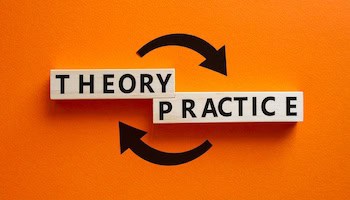
The Thinker is the person who makes full use of the power of his mind. He takes theory and applies it in practice. He observes practice and conceptualizes his observations into new theory. He has an active mind in that he is always observing the world around him, always integrating new knowledge with the old, always looking for the root causes that explain the results he sees. He does this in every area of his life, managing his mind by exploiting his volition, his values, and his knowledge.
This identity does not require a particular degree of intelligence or level of education. Rather, it ensures that you will continually increase your functional intelligence and become self-educated in every area that matters to you.
It does require that you develop certain characteristic ways of thinking. The top five I see are:
- Decisive
- Essentialized
- Principled
- Creative
- Value-Oriented
Each of these is the product of learnable skills.
Decisive
By decisive, I mean able to make a decision in a timely manner and follow through in action. It includes ongoing self-awareness of when you need to make a decision. It requires the willingness to set a standard of timeliness and guide the decision accordingly. Some decisions warrant only a few minutes — such as your choice of lunch from a menu. Some, like your choice of central purpose, can warrant a few months of consideration.
I don’t think I need to make a case for the benefits of decisiveness. It is integral to setting and achieving goals and to any form of leadership, including self-leadership.
But why do I consider it a characteristic of the Thinker identity? That’s because decisions are the mental tool for transforming thought into action. The purpose of thinking is figuring out what to do. If you never decide to do anything, your thinking is wasted.
There are several ways I’ve found to build decisiveness.
1) My basic ability to choose long-range goals and make everyday decisions comes from my commitment to self-awareness and my willingness to introspect and resolve any and all internal conflicts by means of the value-orientation. Re-evaluating options in terms of values at stake makes decisions and follow-through much easier.
2) I’ve honed an ability to hold the context when making a decision, in particular the need for timeliness. Some people get bogged down trying to achieve Platonic certainty before deciding. They wish to guarantee that the decision will turn out well and/or better than the alternative. This is, of course, impossible. This error leads to stagnation and suffering. Factoring in the unknowns, accepting the known risks, and committing to keep your eyes open for new information that would undercut your assumptions are part of what makes a timely decision a good decision in the context.
3) I’m currently building my capacity for follow-through by means of a practice called “deciding ahead of time.” For this, you decide a day in advance what you’re going to do differently from usual, such as what you’re going to eat or how you’re going to exercise. You decide this knowing full well that on the following day, this choice will seem unmotivating and unpleasant. You commit in advance to experiencing this unpleasantness as you take the planned action — no renegotiation, no suppression, no dilly-dallying. Exercising your free will to follow through on a decision made this way creates a profound experience of personal agency.
Essentialized
“Essential” is a value judgment. It implies a “to whom” and a “for what,” one who judges and his purpose. The purpose involved in essentializing is epistemological — to condense a complex body of information into a simple, retainable, “crow-friendly” form that can then serve as a mental hook for retrieving or recreating the details.
So, when you name the theme of an article, you are judging what is the essential message of the author. When you define a concept, you are judging the essential differentiation and integration that must be performed to grasp it. When you essentialize an argument, you are judging the essential points that are needed to logically validate the conclusion.
We admire the essentialized prose of Ayn Rand and Leonard Peikoff that are, of course, products of essentialized thinking. Clarity and precision are necessary but not sufficient for this. The economy of their writing is achieved by means of both differentiating and integrating the material in terms of fundamentals.
Essentialized thinking is needed not just for communication, but for staying on track toward your goal. You need to be able to judge whether a feature of your product or a possible course of action for achieving your goal is essential to your success or a “nice to have.”
I honestly don’t know any way to become more essentialized in your thinking other than the two methods I learned as a student at the Objectivist Graduate Center in the 1990s: Harry Binswanger’s “genus method” for defining terms (which is taught in his logical thinking class) and Peter Schwartz’s method for analyzing an article to determine the main points and theme, sometimes called reverse outlining (which is taught in the writing classes at ARU).
I just know that defining hundreds of terms, reverse outlining all of OPAR and many of Ayn Rand’s articles, and teaching these skills for five years when I first started my business have made a qualitative change in my ability to name an essential. Plus I’ve seen that when Thinking Labbers have dug into my self-study courses on these topics, their minds have noticeably sharpened.
How does that translate into being more essentialized in your thinking in the pursuit of goals? It sensitizes you to differentiate what matters from what doesn’t, to conceptualize processes explicitly, and to look for fundamental explanations. At least that’s the best I can explain it at the moment.
* * *
This is enough for now. I’ll pick up next week with my thoughts on the other characteristics. What do you think of my list of five characteristics — do you think I’m missing anything? Has anyone noticed the two characteristics mentioned in the Objectivist corpus as Ayn Rand’s distinctive method of thinking that are not on this list?





0 Comments