

As many of you know, I have reconceptualized Marshall Rosenberg’s idea of “universal needs” as “deep rational values.” If you are unfamiliar with either of these concepts, I recommend you read my FAQ on the topic, since this article presupposes some familiarity with the idea.
To refresh your recollection, “Deep Rational Values” (DRVs) are values in a philosophic sense. They are phenomena of general theoretical value because they relate to the nature of man, the world, and man’s role in the world; they are good for man in principle. In addition to virtues (such as honesty and courage), DRVs include values related to mental functioning (such as clarity, direction, and efficacy), social values (such as connection, cooperation, and communication), and values pertaining to overall wellness of the organism (such as recreation and resilience).
I have validated my list of DRVs by reference to the philosophy of Objectivism, but I still consider it a work in progress. I see both that these concepts play an important role in managing one’s mind and that Rosenberg’s explanation for what they are is mistaken. As I work this out more clearly, my list evolves. My current list is below:
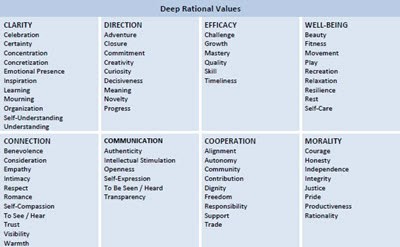
A recent conversation with a Thinking Labber caused me to rethink why I don’t include “money” and “safety” on the list. This same rethinking has caused me to drop “ease.” Bottom line: “Deep Rational Values” need to help you hold the full philosophic context in a tricky situation. “Money,” “safety,” and “ease” don’t.
But we love money!
This does not mean I am anti-money or anti-safety or anti-ease. I am just saying that these are not concepts that help you hold the full philosophic context and integrate your values on principle.
Take money. You value money because it is a means to other ends. But it’s important you hold the context of how that is so.
Any particular money you possess is a value to you only insofar as you can trade it for the products of other people’s work. It is a social value that arises only in a relatively free society in which trade is possible and there is some specialization of labor. If there aren’t people producing values you want who are willing to trade them for your money, it is of no value whatsoever.
This same context explains the value of savings. Savings presuppose that other people will continue to produce goods in the future so you can buy them then. It also presupposes that the society remain free enough that the government doesn’t devalue your money through confiscation, regulation, or inflation.
Ditto investment. Investment presupposes that the people in whom money is invested will use the money to help them create goods and services worth more than the money invested.
When you say you want money, this is the context to hold. Thus, the way you act to gain and keep money is by creating values that other people want and are willing to give you money for.
If you automatically think this way when you say, “I value money” or “I want more money,” good for you. You are probably an entrepreneur, who when he needs money thinks, “Okay, then. I’m going to make some money.” If you are an employee who wants a raise, this context can help you see, “Gee I should talk to my boss to make sure he sees the value I am creating and/or to clarify how I could create more value.” If you are looking for a job, the context helps you ask, “How can I provide amazing value to this company?” Etc.
These are not the first thoughts when most people say “money is a value” or “I value money.” Many people are confused about money. They treat money as an end in itself and discover that getting money doesn’t ensure happiness. Or they undermine the entire system that causes money to be a value by stealing it or lobbying the government for handouts.
That’s why “money” is not on the list of deep rational values. It doesn’t help you hold the philosophic context. In contrast, “freedom,” “productiveness,” and “trade,” which are on the list, do. [Note 1.]
But safety is the foundation of Mazlow’s list!
Similar reasoning explains why “safety” is not on my list, despite its being named by Mazlow as the next critical need to meet after meeting basic physical needs.
The element of truth in this statement is that if you are focused on threats to yourself, you will be in fight-or-flight mode and you cannot think clearly in this state. It is an objective problem; at a minimum, your crow space is severely limited so your operational intelligence is much reduced.
But the solution to this problem is not to get to “safety” per se, it is to manage your mind. This is what soldiers are trained to do in combat situations where they are literally risking their lives. They learn to maintain situational awareness and think strategically in high-stakes circumstances.
Moreover, this is what you need to do if you are driving a car and realize you are at risk of crashing. You need to think to figure out the way to safety in that circumstance. The answer is often counterintuitive — you need to speed up or stay in your lane. If you let emotions take over and react, you will likely do the opposite.
And of course, the idea of safety as a “universal need” includes a feeling of emotional security. Setting a feeling as your goal is a form of emotionalism.
In the face of any threat, it is always possible and desirable to focus your mind, calm your emotions down, and put any threat in context so that you can make a rational decision about what to do about it. [Note 2.] You may choose to seek safety, or to avoid the threat, or to mitigate the threat, or to eliminate the threat, or to develop skill to deal with the threat. Or you might decide the threat is too minor to worry about, so you’ll take what you want and pay for it.
You have many choices in how you deal with threats; taking risks is part of life. Life requires action to gain values in the face of risks. Courage is a virtue. Challenge is inherent in growth. Growth is necessary to happiness.
That’s why “safety” is not on the list of deep rational values. It doesn’t help you hold the philosophic context. In contrast, “courage,” “growth,” and “resilience,” which are on the list, do.
And we don’t love hard!
Similar reasoning applies to “ease.” Doing something that is easy feels good. You get a sense of control and efficacy. Most of the time, you’d like hard things to be easy. That eliminates any chance of feeling self-doubt when you realize you aren’t sure that you can do what you are trying to do.
But what makes one task easy and another hard? Usually it’s your skill level! Skill is a product of past action that developed the skill. Sometimes a task is easy because you have designed it to be within your skill level. That means it’s a result of past self-awareness in which you observed your skill level, plus past thinking in which you created a process that is compatible with your current skill level.
As a generalization, work is not easy. That’s why we call it work. It requires concentration, effort, resilience. Sometimes it is, and that’s a delight. But the better way to be productive is to learn how to do hard things in a way that is emotionally satisfying, i.e., a way that creates confidence and pride.
As a generalization, recreation is easy. It’s one of the reasons we need leisure — to have the experience of efficacy and refill our emotional reservoirs. But often recreation involves something hard but different from your work (to give your mind a break). Or it involves developing a skill (which is not easy) for no reason other than your own desire to grow your capacities.
What I’ve found is that when people focus on gaining “ease,” they often are not looking carefully at the full context to understand why something is hard or is triggering self-doubt. Wanting “ease” sidesteps the need to understand why they’re exerting the effort in the first place, whether the payoff is worth the effort, and if the process is suitable for their current skill. That’s the context that needs to be held.
That’s why I took “ease” off the list of deep rational values after having included it for many years. It doesn’t help you hold the philosophic context. In contrast, “recreation,” “skill,” and “self-understanding,” which are on the list, do.
Take a philosophic perspective
As my understanding evolves, I have encouraged people to look at other lists of “universal needs” and decide for themselves what goes on such a list, even though I am certain (contextually certain) that my list is right.
The reason I recommend this is that I think it’s important that you understand the philosophic importance of these concepts. And for that, you need to think about each item to see if it meets the three criteria I set in the article I referenced above.
Check if for each concept:
- You can make the case that anyone with life as his standard of value can agree, all things being equal, that having this in your life is better than not having it. It is a value in the philosophic sense.
- You can make the case that its value is connected to the faculty of reason being man’s basic means of survival. It supports the complex needs of a human mind. This is what makes it a rational value.
- You can make the case that its value is a value in principle.
In this article, I have elaborated on #3. What makes a DRV a value in principle is that it helps you hold the full philosophic context needed to make value judgments in a given area. I hope you find this clarifying.
* * *
I learned about Deep Rational Values from studying Marshall Rosenberg’s book, Nonviolent Communication (NVC), which is the basis of the Better Relationships 4-day intensive that I run periodically. (Save the dates and get on the waiting list — the next one is March 10–13.)
For those who are interested in the skill, my colleague and friend Shona Cameron has a practice group to study NVC starting soon.
* * *
Note 1: See the entry on “money” in the Ayn Rand Lexicon for reference: https://aynrandlexicon.com/lexicon/money.html.
Note 2: Conceivably, there could be exceptions in a bona fide emergency when you literally cannot stop to think for even 30 seconds. But there is no “should” in such a situation either. See the Ayn Rand Lexicon on “emergencies”: https://aynrandlexicon.com/lexicon/emergencies.html.






0 Comments