
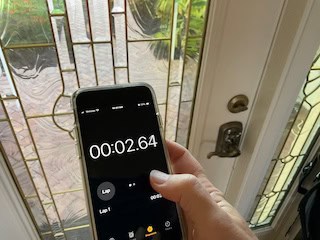
As soon as you finish reading this article, I recommend that you take out your smartphone, open the stopwatch app, start the timer, and then march out of the building. Keep going until the stopwatch hits 90 seconds, then turn around and come back.
You will have defined a 3-minute walk.
How a pre-defined 3-minute walking route benefits you
Then I recommend that you walk this exact 3-minute route the next time you get stuck. Or are tempted to break your diet. Or resist doing the next task on your agenda. Or realize you are in a funk. Etc. It will help whenever you have some motivational problem brewing.
Stopping what you are doing to clear your head with a short walk is a benefit in itself. It will re-energize you. But my actual advice is to use this time to think aloud about the problem you are facing. (Or “think aloud silently” [1], i.e., think in full sentences in your head, but don’t say the sentences out loud.)
Often I have recommended three minutes of “thinking on paper” to address any problem. But thinking aloud while walking can be a better choice when you are at risk of motivational failure. It guarantees that you break out of any thinking loop you are in, because you need to turn your attention to standing up and heading for the outside world. Once you’re on the walk, you need something to think about — and behold, you have an issue ready-made. When you turn around to go back, you get visual feedback that you need to hustle a bit to reach a conclusion before your three minutes are up. This helps you stop complaining or ruminating and start problem-solving, if you were bogging down.
But you get these benefits only if you took the three minutes to define your route in advance. And it sure helps if you have some prompts prepared, too.
Pre-planned prompts make it easier
I find thinking aloud silently a little harder than thinking on paper, so it helps to have memorized a simple three-point set of prompts to guide the process.
For example, you could use this generic problem-solving question sequence:
- What exactly is the problem?
- What do I wish could be done?
- What’s one thing I can do now to address this?
Or this generic introspection sequence:
- What am I feeling?
- Why am I feeling it?
- What’s the top value at stake?
My favorite is to use a little sequence of instructions I call “Have Your Own Back”:
- Don’t run away.
- Don’t melt down.
- Don’t stab yourself in the back.
Translated into plain English, “Have Your Own Back” looks like this:
“Don’t run away” means: Don’t run away from any facts or feelings. The facts need to be acknowledged. The feelings need to be experienced and introspected. What are they?
“Don’t melt down” means: Strengthen your spine — call on your courage. It is your life, your values, your happiness at stake in this moment. So identify the top value at stake and recommit to going after it. What is it?
“Don’t stab yourself in the back” means: If some old baggage has gotten triggered, don’t let it take over. There are lots of tactics for reframing and re-orienting to values. So don’t let some old pattern get triggered here. What temptation will you avoid?
I recently held a class on “Have Your Own Back” in the Thinking Lab under the more formal heading of “activating a self-esteem context.” Yes, it helps with that. Yesterday I took a 3-minute walk to “have my own back” three times when I got bogged down in writing. Today I have already used it once.
But any of these prompts (or many others) can be simple and easy to use during your 3-minute walk. Whichever prompts I use, when I walk back in the door, I have shifted my perspective and my motivation, and I am energized to tackle the problem afresh. This little exercise always gets me over the hump. Even if I can’t solve the problem in three minutes, I can figure out a way forward.
It helps to practice the processes at your desk
As you may guess from these examples, your ability to think through an issue in three minutes using a particular set of prompts may require some familiarity with the prompts. So you may want to test-drive them. The more you think on paper at your desk using a particular set of prompts, the easier it is to remember the sequence and the easier it is to answer the questions or take the steps.
You may also need to practice thinking at your desk if you have trouble going step by step. If your “thinking” looks more like free-associating, ruminating, or going in circles, you need to practice thinking per se. Thoughts going through your mind without progress toward a goal don’t qualify as thinking. Thinking is a purposeful process of integrating past conclusions with your observations about the present situation and the goal you have at the moment, in order to figure out something new — such as what to do right now.
If you want general practice in thinking purposefully, I recommend you purchase the Thinker’s Toolkit and not only read the first two articles on “thinking on paper,” but also the third article on “Using Prepared Questions to Activate What You Know.” There are 31 sets of question prompts in that article on various topics. If you practice looking up and using those prompts when you need some help, you’ll grasp how powerful a pre-existing structure can be for thinking. It’s like scaffolding you can stand on while you’re erecting a building.
An easy way to regain momentum
Problem-solving during a 3-minute walk is a fast and easy way to regain momentum when you hit a motivational block. The defined amount of time keeps you on track. And the return to the starting place reminds you to make the final, pro-active shift to thinking about what you can do that would be constructive.
I don’t mind walking in the rain, but you might want two routes — one for good weather and one for bad. Or you might want routes for both home and work. I will be writing while on a vacation in the woods next week, and early in my trip I will map out a 3-minute walk.
Note:
[1] Hat Tip to Lee Pierson, who coined the term “thinking aloud silently” to sum up this process.





I want to know more
Glad you find it interesting.
There’s a video version of this article on the site: https://www.thinkingdirections.com/videos/
And it’s discussed in self-study courses in the Thinking Lab:
https://www.thinkingdirections.com/join-the-thinking-lab/
Yours,
Jean M.
This is excellent. I love DR GINA GORLIN too. Handshake to DR HBL! “I swear by my life and my love of it that I will never live for the sake of another man, nor ask another man to live for mine.”
IF:: If you can keep your head when all about you Are losing theirs and blaming it on you; If you can trust yourself when all men doubt you, But make allowance for their doubting too: If you can wait and not be tired by waiting, Or, being lied about, don’t deal in lies, Or being hated don’t give way to hating, And yet don’t look too good, nor talk too wise; If you can dream—and not make dreams your master; If you can think—and not make thoughts your aim, If you can meet with Triumph and Disaster And treat those two impostors just the same: If you can bear to hear the truth you’ve spoken Twisted by knaves to make a trap for fools, Or watch the things you gave your life to, broken, And stoop and build’em up with worn-out tools; If you can make one heap of all your winnings And risk it on one turn of pitch-and-toss, And lose, and start again at your beginnings, And never breathe a word about your loss: If you can force your heart and nerve and sinew To serve your turn long after they are gone, And so hold on when there is nothing in you Except the Will which says to them: “Hold on!” If you can talk with crowds and keep your virtue, Or walk with Kings—nor lose the common touch, If neither foes nor loving friends can hurt you, If all men count with you, but none too much: If you can fill the unforgiving minute With sixty seconds’ worth of distance run, Yours is the Earth and everything that’s in it, And—which is more—you’ll be a Man, my son! MONEY IS GOOD. — MOST CORDIALLY MR EDMUND BONCZYK
Thanks for your enthusiasm, Edmund. FYI, I cut one political sentence from your comment. I keep the site politics free. -JFM