
When you believe you have more knowledge and/or experience than another person, it can be tempting to give him advice. Sometimes he even asks for it. But advice is not as helpful as you might suppose. If you haven’t worked to understand the exact problem, your advice will likely be misguided or irrelevant. On the other hand, if you put the other person through an inquisition so you can understand his problem and determine his solution, you come off as controlling and/or patronizing.
And yet, many of us want to help others. As my friend Catherine Dickerson taught me, the solution is to let the other people do their own thinking, especially if you are in a leadership position. This respects their autonomy and ensures that you don’t set up a co-dependent relationship between you. It is a lesson that everyone benefits from learning, but especially managers, coaches, and parents.
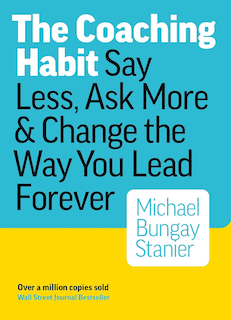
Despite being sold on this goal, I have had some trouble figuring out how to be helpful without just giving my opinion. Then I read The Coaching Habit by Michael Bungay Stanier. I highly recommend it.
1 process, 7 questions and 8 application lessons
The book is a fast read, maybe only 75 pages of text if it were formatted differently. But it is chock full of useful material.
It begins with a chapter on basic habit change — because if you are prone to giving unsolicited advice, you have some bad habits to break. It then encourages you to apply that process as you learn each of 7 questions.
The 7 questions have catchy names: “The Kickstart Question,” “The Focus Question,” “The Lazy Question,” etc. But more than that, they are carefully crafted and explained in great detail as to why they are so useful.
For example, the “Focus Question” is: “What’s the real challenge here for you?” Stanier explains that the word “real” gets them to think rather than ramble about all of the issues. The word “you” gets them to be concrete and specific, rather than describe the problem in abstract, general terms. If you want to solve a problem, the first step is to identify it precisely. This question does that.
Sprinkled among the habit-change material and the questions are 8 short lessons on question-asking tactics.
One is, “Get comfortable with silence,” a lesson my graduate advisor taught me long ago. After you ask the question, be prepared to wait for an answer as long as needed. The other person may need time to think, and your waiting shows you are serious about letting him do just that.
Objective helping
I particularly appreciate Stanier’s discussion of two helping questions, “What do you want?” and “How can I help?” You might shy away from them, misconstruing them as obligating you to do something for the other person. But they don’t — they get the other person to essentialize the issue so you can discuss it.
Regarding “What do you want?” Stanier quotes another author (Peter Block), who “defined an adult-to-adult relationship as one in which you are ‘able to ask for what you want, knowing that the answer may be No.'” Amen to that! And he encourages you to tell them what you want after you find out what they want. How can you have an open, honest, equal conversation without getting your values on the table?
On the topic of, “How can I help?” he points out how useful it is to elicit a clear, direct request. Again, you do not have to say “yes.” But more importantly, this starts a conversation about other possible solutions — and it ensures that the other person does the thinking he needs to do about what a solution might be.
These are just two examples of how objective the book is, and I mean that in the full, technical sense of the term. Values are objective, in that they are of value to someone for something. Keeping clear on each person’s individual values in a conversation is part of the art.
Better than any book on questions I’ve read
Question-asking is essential to thinking, so I’ve been culling useful questions from books and teachers my entire career. And I’ve read several books devoted to “smart” questions or “networking” questions or question-asking in general. But I’ve never found a book from which I learned so much about what makes a question useful, in such a concentrated form. Or for which the questions seem natural and not forced.
This book was a Wall Street Journal bestseller, with over a million copies sold, and I can understand why. After I read it, I was amused to realize that in just the previous month, one of my doctors and my speaking coach had independently used these techniques with me.
Highly recommended.



0 Comments